- New
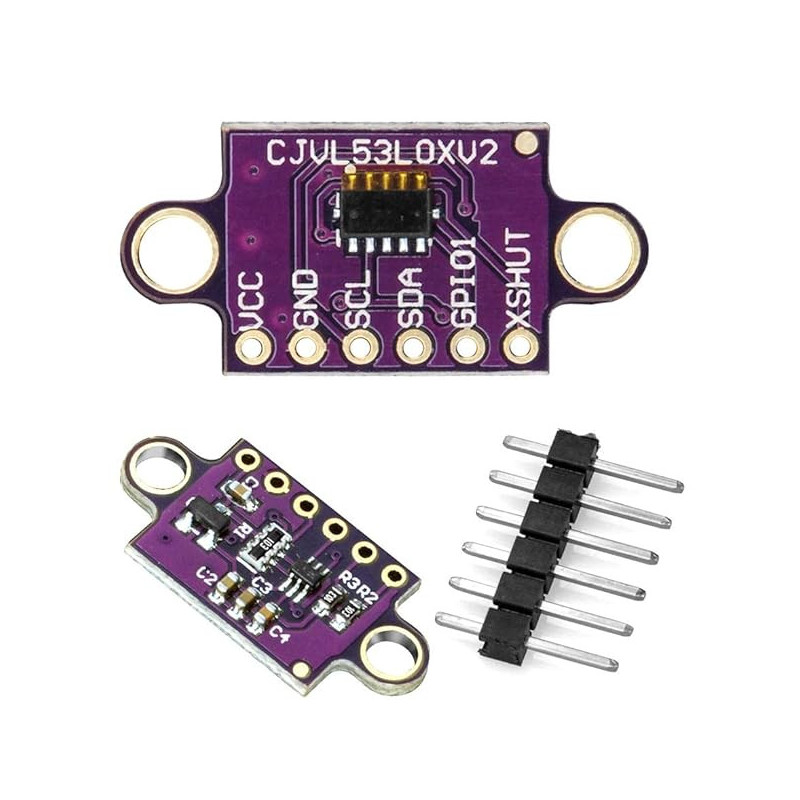

Distance-sensing module based on the VL53L0X, featuring Time-of-Flight technology, a 940 nm infrared emitter and a maximum range of up to 2 metres. It communicates through I²C and is suitable for Arduino, ESP32 and Raspberry Pi projects.

Security policy

Delivery policy
The GY-VL53L0X is a distance-measurement module based on Time-of-Flight — ToF technology. Rather than estimating distance solely from the intensity of reflected light, it measures the time taken for an infrared light pulse to reach the target and return to the sensor.
The VL53L0X integrates a 940 nm VCSEL emitter, a SPAD photodiode array and the processing required to provide the measured distance directly through its I²C interface.
It can measure absolute distances of up to approximately 2 metres, depending on the operating mode, ambient lighting, target size, position and reflectivity. Reported values have a 1 mm resolution, with a stated typical accuracy of approximately ±3% under suitable conditions.
The carrier board includes voltage regulation and I²C level adaptation, normally allowing it to be connected to systems using 3.3 or 5 V power and logic. Hardware shutdown and programmable interrupt signals are also available.
The stated 2-metre range is a maximum value, normally achieved under favourable conditions and with a long-range operating mode. Effective range and accuracy can be affected by intense sunlight, very small targets and extremely dark, transparent, reflective or unfavourably angled surfaces.
The 1 mm resolution describes the increment of the reported readings and does not necessarily represent an absolute accuracy of ±1 mm under all conditions.
The VL53L0X uses the default I²C address 0x29. To use multiple sensors on the same bus, control each XSHUT pin separately and assign a different address to each sensor in software after every power-up.
Do not cover or touch the optical windows. Although classified as a Class 1 laser under normal operating conditions, the emitter should not be viewed directly through magnifying optical instruments.
Data sheet
Distance-sensing module based on the VL53L0X, featuring Time-of-Flight technology, a 940 nm infrared emitter and a maximum range of up to 2 metres. It communicates through I²C and is suitable for Arduino, ESP32 and Raspberry Pi projects.