• New
DXpatrol GPSDO V2.0 – 4 × 10 MHz Outputs
search
  • DXpatrol GPSDO V2.0 – 4 × 10 MHz Outputs
  • DXpatrol GPSDO V2.0 – 4 × 10 MHz Outputs
  • DXpatrol GPSDO V2.0 – 4 × 10 MHz Outputs
  • DXpatrol GPSDO V2.0 – 4 × 10 MHz Outputs

DXpatrol GPSDO V2.0 – Precision 10 MHz Reference with 4 Outputs

€140.00

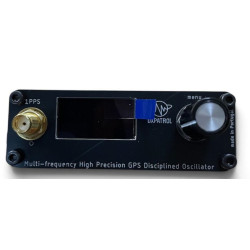
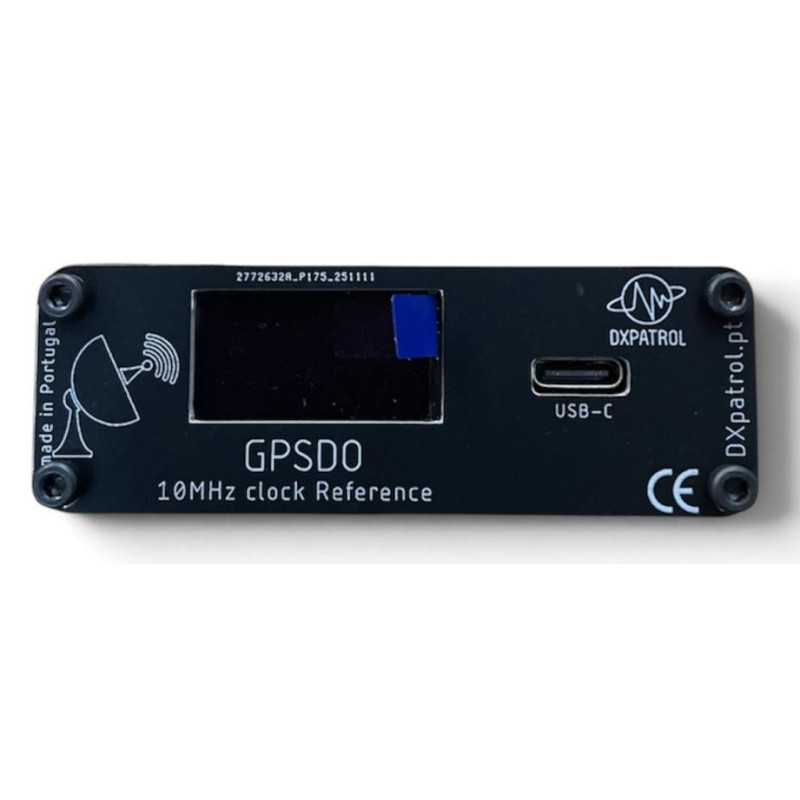
GPS-disciplined reference oscillator with four fixed 10 MHz outputs, comprising three sine-wave outputs and one square-wave output. It includes an OLED display, stabilised OCXO, GPS/GLONASS/Galileo support and a GNSS antenna with a 3-metre cable.

Quantity


Security policy


Delivery policy

The DXpatrol GPSDO V2.0 is a high-stability frequency reference designed for amateur radio equipment, QO-100 systems, transverters, SDR equipment, laboratory instruments and microwave applications.

The unit combines a GNSS receiver with an internal 10 MHz OCXO. The OCXO frequency is continuously compared with and corrected by the satellite-derived timing reference, providing excellent long-term stability.

It provides four simultaneous 10 MHz outputs: three sine-wave outputs and one square-wave output. This allows several devices to be supplied from the same reference and kept synchronised.

The OLED display shows UTC time, geographic coordinates, the number of received satellites and acquisition or lock status. The receiver supports the GPS, GLONASS and Galileo constellations.

The V2.0 uses an improved PLL architecture, allowing initial lock in approximately one minute when the antenna has a clear view of the sky. Approximately five minutes should be allowed for complete thermal stabilisation after power-up.

Main features

  • Fixed 10 MHz frequency reference
  • Four simultaneous outputs
  • Three sine-wave outputs
  • One square-wave output
  • Internal GNSS-disciplined OCXO
  • GPS, GLONASS and Galileo receiver
  • High-stability PLL architecture
  • High-contrast OLED display
  • Wait and lock indication
  • UTC time display
  • Geographic-coordinate display
  • Received-satellite count
  • Temporary OCXO operation without a GNSS signal
  • Compact metal enclosure
  • GNSS antenna included

Technical specifications

  • Brand: DXpatrol
  • Model: GPSDO V2.0
  • Type: GPS/GNSS-disciplined oscillator
  • Output frequency: 10 MHz
  • Number of outputs: 4
  • Sine-wave outputs: 3
  • Square-wave outputs: 1
  • Sine-wave output level: approximately +7 dBm
  • Approximate amplitude: 1.5 Vpp
  • Square-wave duty cycle: approximately 50%
  • Output connectors: SMA
  • Supported constellations: GPS, GLONASS and Galileo
  • Internal oscillator: 10 MHz OCXO
  • Indicative GNSS lock time: approximately 1 minute
  • Recommended thermal stabilisation time: approximately 5 minutes
  • Recommended supply voltage: 8 to 14 V DC
  • Warm-up current: approximately 600 mA
  • Current after stabilisation: approximately 270 mA
  • Operating temperature: 0 to 75 °C
  • Approximate internal OCXO temperature: 50 °C
  • Approximate dimensions: 84 × 71 × 25 mm
  • Enclosure: metal

Stated performance

  • Phase noise at 1 Hz: approximately -80 dBc/Hz
  • Phase noise at 10 Hz: approximately -120 dBc/Hz
  • Phase noise at 1 kHz: approximately -145 dBc/Hz
  • Phase noise at 10 kHz: approximately -150 dBc/Hz
  • Second-harmonic suppression: greater than approximately 51 dB
  • Third-harmonic suppression: greater than approximately 56 dB

Displayed information

  • UTC time
  • Geographic coordinates
  • Number of received satellites
  • Signal-acquisition status
  • Waiting indication
  • Lock and synchronisation indication

Recommended applications

  • External 10 MHz reference for QO-100
  • Upconverter and downconverter synchronisation
  • Microwave transverters
  • SDR equipment
  • Amateur radio receivers and transmitters
  • Frequency counters
  • Signal generators
  • Laboratory instruments
  • Beacons and repeaters
  • Microwave and millimetre-wave systems
  • RF equipment calibration and synchronisation

Package contents

  • 1 DXpatrol GPSDO V2.0
  • 1 GPS/GNSS antenna with an approximately 3-metre cable

Important note

For fast and stable lock, install the GNSS antenna where it has a clear view of the sky. Indoor reception may be insufficient or significantly increase synchronisation time.

The unit can continue providing a 10 MHz signal from its OCXO during a temporary loss of GNSS reception. During this period, however, the frequency is no longer being actively disciplined by the satellites.

The enclosure becoming warm during operation is normal, as the OCXO maintains an internal temperature of approximately 50 °C.

The power supply and SMA cables are not stated as included.

102100
New