
- New
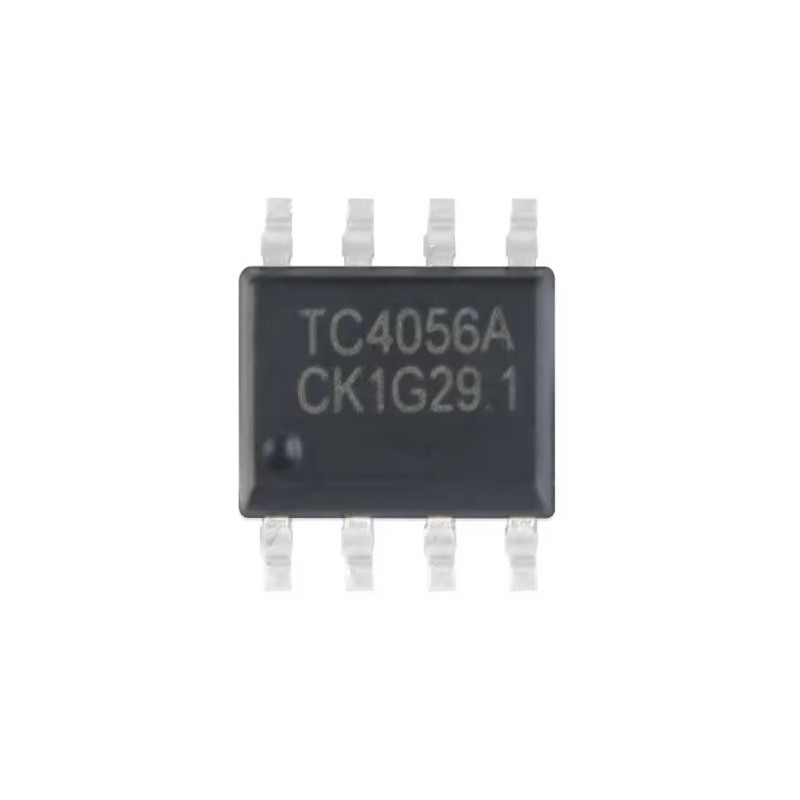

Linear charger IC for one lithium-ion or Li-Po cell, featuring a 4.2 V charge voltage, programmable current up to 1 A, thermal regulation and charge-status outputs.

Security policy

Delivery policy
The TC4056A is an integrated circuit designed to charge a single lithium-ion or lithium-polymer cell with a nominal voltage of 3.7 V and a maximum charge voltage of 4.2 V.
It uses a constant-current/constant-voltage charging process and allows the charging current to be programmed using an external resistor. The maximum current can reach 1 A, provided the power supply, PCB design and thermal dissipation are suitable.
Integrated thermal regulation automatically reduces the charge current when the internal temperature becomes excessive, protecting the circuit and helping maintain stable operation.
Charging terminates automatically when the current falls to approximately one tenth of the programmed value after reaching the final voltage. Automatic recharge restarts the charging process when the battery voltage decreases.
Two status outputs can indicate charging and charge completion using external LEDs. The ESOP-8 package, similar to SOP-8 but with an exposed thermal pad underneath, helps transfer heat into the printed circuit board.
This product is an SMD integrated circuit, not a complete charger module. It requires a printed circuit board, external components and suitable soldering equipment.
The TC4056A controls battery charging but should not be considered a complete short-circuit, overcurrent or over-discharge protection system. Add a suitable protection circuit when using an unprotected cell.
The exposed thermal pad must be correctly soldered to a suitable PCB copper area. At charge currents close to 1 A, insufficient heat dissipation may cause the thermal regulation system to reduce the charging current significantly.
Do not use this IC with LiFePO₄ batteries, multi-cell series packs or cells with a maximum charge voltage other than 4.2 V.
Data sheet
Specific References
Linear charger IC for one lithium-ion or Li-Po cell, featuring a 4.2 V charge voltage, programmable current up to 1 A, thermal regulation and charge-status outputs.


