• New
ESP32-C3 SuperMini Wi-Fi Bluetooth 5 LE 4 MB USB-C
search
  • ESP32-C3 SuperMini Wi-Fi Bluetooth 5 LE 4 MB USB-C
  • ESP32-C3 SuperMini Wi-Fi Bluetooth 5 LE 4 MB USB-C

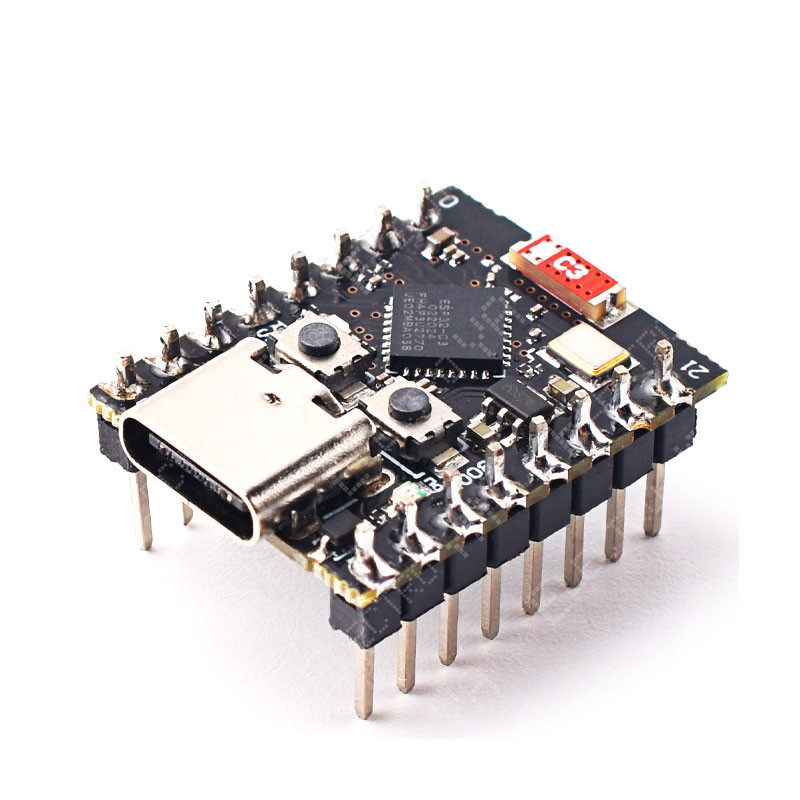
ESP32-C3 SuperMini Development Board with Wi-Fi, Bluetooth 5 LE, 4 MB Flash and USB-C

€6.45

Ultra-compact development board based on the ESP32-C3, featuring a 32-bit RISC-V processor running at up to 160 MHz, 2.4 GHz Wi-Fi, Bluetooth 5 Low Energy, 4 MB Flash memory and direct programming through USB-C.

Quantity


Security policy


Delivery policy

The ESP32-C3 SuperMini is a compact development board suitable for IoT projects, wireless sensors, automation, smart-home systems and portable devices.

The ESP32-C3 microcontroller integrates a single-core 32-bit RISC-V processor operating at up to 160 MHz, together with Wi-Fi and Bluetooth Low Energy connectivity.

The board includes 4 MB of Flash memory, approximately 400 KB of internal SRAM and an integrated antenna, removing the need for separate wireless modules in most projects.

Its USB-C port can be used for power, programming and serial-console access through the ESP32-C3’s native USB Serial/JTAG controller, without requiring an external USB-to-UART converter.

The SuperMini form factor measures approximately 22.5 × 18 mm and features 2.54 mm pin spacing, making it suitable for breadboards and custom printed circuit boards.

Main features

  • ESP32-C3 microcontroller
  • 32-bit RISC-V processor
  • Single core running at up to 160 MHz
  • 2.4 GHz IEEE 802.11 b/g/n Wi-Fi
  • Bluetooth 5 Low Energy
  • Bluetooth LE Long Range support
  • 4 MB Flash memory
  • 400 KB internal SRAM
  • Integrated wireless antenna
  • USB-C port for power and programming
  • Native USB Serial/JTAG controller
  • BOOT and RESET buttons
  • Integrated blue LED
  • Ultra-compact form factor
  • 2.54 mm pin spacing
  • Compatible with ESP-IDF, Arduino and Zephyr

Technical specifications

  • Type: development board
  • Microcontroller: ESP32-C3
  • Architecture: 32-bit RISC-V
  • CPU cores: 1
  • Maximum clock speed: 160 MHz
  • Internal ROM: 384 KB
  • Internal SRAM: 400 KB
  • Installed Flash memory: 4 MB
  • Wi-Fi: IEEE 802.11 b/g/n
  • Wi-Fi frequency: 2.4 GHz
  • Maximum theoretical Wi-Fi speed: up to 150 Mbps
  • Bluetooth: Bluetooth 5 Low Energy
  • Bluetooth Classic: no
  • Antenna: integrated
  • USB: native USB Serial/JTAG
  • USB connector: USB-C
  • USB-C supply voltage: 5 V DC
  • GPIO logic voltage: 3.3 V
  • On-board regulator: 5 V to 3.3 V
  • Pin spacing: 2.54 mm
  • Approximate dimensions: 22.5 × 18 mm
  • Integrated LED: blue, connected to GPIO8
  • BOOT button: GPIO9
  • RESET button: yes
  • ESP32-C3 interfaces: UART, SPI, I²C, I²S, ADC, PWM, JTAG and TWAI
  • Quantity: 1 piece

Commonly exposed GPIO

Depending on the board revision, the following connections are normally available:

  • GPIO0
  • GPIO1
  • GPIO2
  • GPIO3
  • GPIO4
  • GPIO5
  • GPIO6
  • GPIO7
  • GPIO8 – integrated LED
  • GPIO9 – BOOT button
  • GPIO10
  • GPIO20 – RX
  • GPIO21 – TX
  • 3V3
  • 5V
  • GND

UART, SPI, I²C, PWM and other peripheral functions can be routed to different GPIO through the ESP32-C3 GPIO matrix, subject to the limitations of each pin.

Security features

  • Secure Boot
  • Flash encryption
  • Hardware AES acceleration
  • SHA acceleration
  • RSA acceleration
  • Random-number generator
  • HMAC
  • Hardware digital signature

Supported development environments

  • ESP-IDF
  • Arduino IDE with ESP32 support
  • PlatformIO
  • Zephyr

Recommended applications

  • Internet of Things projects
  • Wi-Fi or Bluetooth sensors
  • Smart-home and home-automation systems
  • Remote monitoring
  • Wireless controllers
  • Data logging and transmission
  • Battery-powered devices
  • Robotics
  • Educational projects
  • Compact electronics prototypes

Package contents

  • 1 ESP32-C3 SuperMini development board

Important note

The ESP32-C3 GPIO use 3.3 V logic and are not 5 V tolerant. Do not apply 5 V directly to an input or output pin, as this may permanently damage the microcontroller.

The board can be powered with 5 V through the USB-C port or 5 V pin. Sensors and modules connected to the GPIO must use 3.3 V-compatible logic levels or a suitable level converter.

The integrated LED on GPIO8 may use inverted logic on some revisions. The board pinout may also vary slightly between manufacturers, so check the markings or pinout supplied with the board before making connections.

The USB-C port uses the native USB Serial/JTAG controller and does not operate as a general-purpose USB OTG port. USB-C cable not included.

100292