• New
Seeed Studio XIAO ESP32C3 Wi-Fi and Bluetooth 5.0
search
  • Seeed Studio XIAO ESP32C3 Wi-Fi and Bluetooth 5.0
  • Seeed Studio XIAO ESP32C3 Wi-Fi and Bluetooth 5.0
  • Seeed Studio XIAO ESP32C3 Wi-Fi and Bluetooth 5.0
  • Seeed Studio XIAO ESP32C3 Wi-Fi and Bluetooth 5.0
  • Seeed Studio XIAO ESP32C3 Wi-Fi and Bluetooth 5.0

Seeed Studio XIAO ESP32C3 Wi-Fi and Bluetooth 5.0 Development Board – 113991054

€7.90

Ultra-compact development board based on the ESP32-C3, featuring a 32-bit RISC-V processor running at up to 160 MHz, 2.4 GHz Wi-Fi, Bluetooth 5.0 BLE, 4 MB Flash and integrated charging for a 3.7 V lithium battery.

Quantity


Security policy


Delivery policy

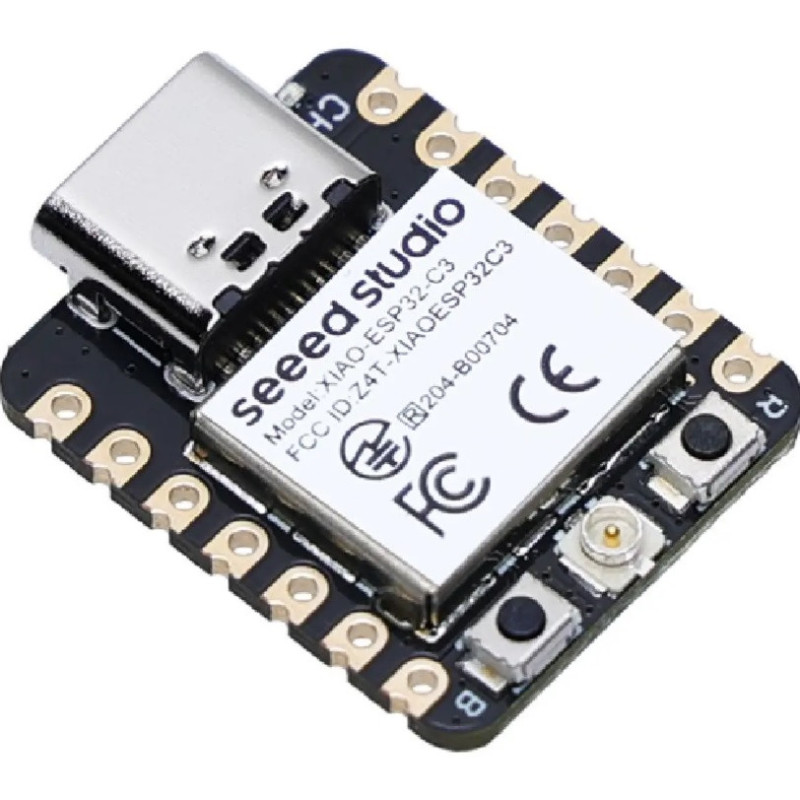
The Seeed Studio XIAO ESP32C3 is a compact and efficient development board designed for Internet of Things projects, automation, wireless sensors and portable devices.

Its ESP32-C3 microcontroller integrates a 32-bit RISC-V processor operating at up to 160 MHz, 400 KB of SRAM and 4 MB of Flash memory. Wireless connectivity includes 2.4 GHz IEEE 802.11 b/g/n Wi-Fi, Bluetooth Low Energy 5.0 and Bluetooth Mesh.

Despite measuring only 21 × 17.8 mm, the board provides 11 PWM-capable GPIO, four analogue inputs, UART, I²C and SPI interfaces. Programming and power are available through its USB Type-C port.

An integrated power management and charging circuit supports a 3.7 V lithium battery, making the board suitable for portable and battery-powered applications. Deep-sleep consumption of approximately 44 µA helps extend battery life.

The single-sided component layout, castellated side pads and standard XIAO form factor allow the board to be used on breadboards, expansion boards or directly as a surface-mount module on a custom PCB.

Main features

  • Manufacturer: Seeed Studio
  • Model: XIAO ESP32C3
  • Part number: 113991054
  • Microcontroller: Espressif ESP32-C3
  • Architecture: 32-bit RISC-V
  • Processor: single core
  • Maximum clock speed: 160 MHz
  • SRAM: 400 KB
  • Flash memory: 4 MB
  • Wi-Fi: 2.4 GHz IEEE 802.11 b/g/n
  • Wi-Fi modes: Station, SoftAP and Station + SoftAP
  • Bluetooth: Bluetooth Low Energy 5.0
  • Bluetooth Mesh: supported
  • Digital GPIO: 11
  • PWM outputs: up to 11 compatible GPIO
  • Analogue inputs: 4 ADC
  • Interfaces: UART, I²C and SPI
  • Debug interface: bottom JTAG pads
  • USB connector: USB Type-C
  • Onboard buttons: Boot and Reset
  • Antenna connector: U.FL/I-PEX
  • External antenna: included
  • Logic voltage: 3.3 V
  • VIN/USB input: 5 V
  • Battery input: 3.7 V lithium battery
  • Fast charging current: approximately 380 mA
  • Trickle charging current: approximately 40 mA
  • Specified maximum 3.3 V output current: 500 mA under the stated conditions
  • Active Wi-Fi consumption: approximately 75 mA
  • Wi-Fi Modem-sleep consumption: approximately 25 mA
  • Wi-Fi Light-sleep consumption: approximately 4 mA
  • Deep-sleep consumption: approximately 44 µA
  • Operating temperature: -40 to +85 °C
  • Dimensions: 21 × 17.8 mm
  • Mounting: breadboard, soldered headers or surface mount
  • Side terminals: castellated pads
  • Component layout: single-sided

Main pin assignment

  • D0 / A0: GPIO2 / ADC
  • D1 / A1: GPIO3 / ADC
  • D2 / A2: GPIO4 / ADC
  • D3 / A3: GPIO5 / ADC
  • D4: GPIO6 / SDA
  • D5: GPIO7 / SCL
  • D6: GPIO21 / TX
  • D7: GPIO20 / RX
  • D8: GPIO8 / SCK
  • D9: GPIO9 / MISO
  • D10: GPIO10 / MOSI
  • Power: 5 V, GND and 3.3 V

Programming compatibility

  • Arduino IDE
  • PlatformIO
  • ESP-IDF
  • MicroPython
  • ESP32 libraries and ecosystem

Recommended applications

  • Internet of Things projects
  • Wireless sensors
  • Home automation
  • Remote monitoring
  • Portable and wearable devices
  • Battery-powered equipment
  • Data logging and transmission
  • Wi-Fi or Bluetooth control
  • Compact prototypes
  • Custom PCB integration
  • Educational and experimental projects

Package contents

  • 1 Seeed Studio XIAO ESP32C3 board
  • 1 external 2.4 GHz antenna with U.FL/I-PEX connection

Important note

The board uses 3.3 V logic levels. Do not apply 5 V signals directly to the GPIO, as this may damage the microcontroller.

The lithium battery must be connected to the dedicated pads with the correct polarity. Use only suitable, protected 3.7 V batteries. The battery and USB Type-C cable are not included.

GPIO2, GPIO8 and GPIO9 are also boot-strapping pins. External circuits connected to these pins may prevent the board from starting or being programmed if they alter the pin states during boot.

The A3 analogue input uses ADC2 and may provide less reliable readings under certain conditions. For more stable analogue measurements, A0, A1 or A2 are recommended.

991054

Specific References

MPN
113991054
New