- New
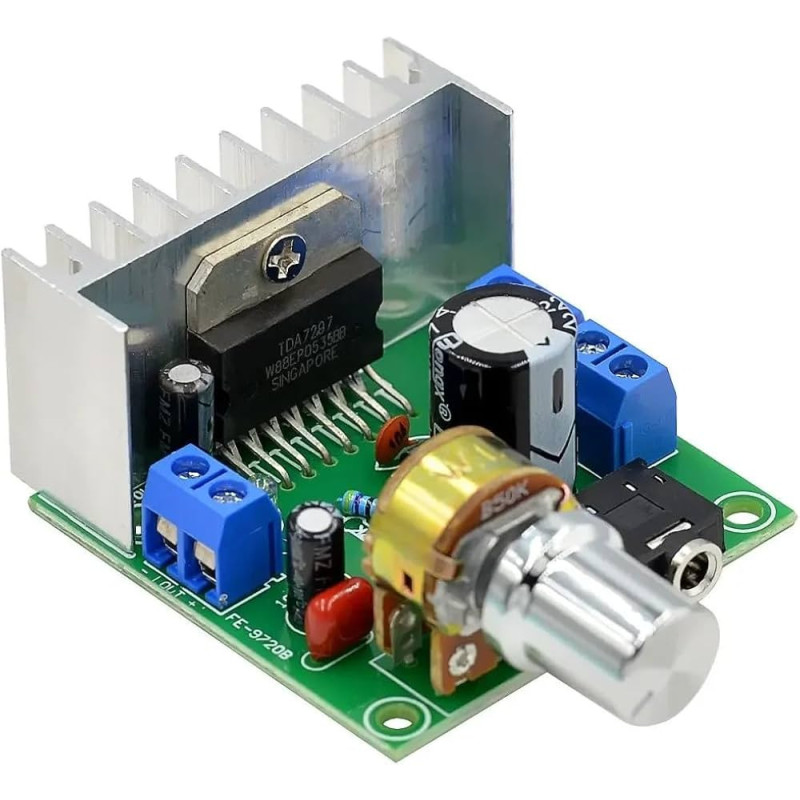


Stereo audio amplifier module based on the TDA7297, with a nominal maximum output of 15 W + 15 W, 9–15 V DC supply, 3.5 mm AUX input and an integrated stereo volume-control potentiometer.

Security policy

Delivery policy
This stereo amplifier module uses the TDA7297, a Class-AB power amplifier IC with two independent bridge-output channels.
It can amplify signals from smartphones, computers, MP3 players, Bluetooth modules, radios and other analogue line-level audio sources.
Audio is connected through a 3.5 mm stereo input, while the integrated potentiometer simultaneously adjusts the volume of both channels.
The module is supplied assembled, with a heat sink and screw terminals for connecting two speakers. A regulated 12 V DC power supply rated for at least 2 A is recommended for normal use.
It provides a compact solution for powered speakers, equipment repairs, portable audio systems and electronics projects.
Connect a regulated 9–15 V DC supply while carefully observing positive and negative polarity.
For typical operation, use a 12 V DC / 2 A or higher power supply capable of powering both channels simultaneously.
Connect a stereo line-level audio source to the 3.5 mm AUX input.
Suitable sources include:
Connect one speaker to each output terminal, following the left- and right-channel polarity markings.
The 15 W per channel rating corresponds to the IC test conditions of approximately 16.5 V, an 8 Ω load and 10% total harmonic distortion. With a 12 V supply, the usable output power will be lower, particularly when low distortion is required.
The speaker outputs use a BTL bridge configuration. Therefore:
When using 4 Ω speakers, use moderate supply voltage and volume and ensure adequate ventilation, as output current and heat will be higher. 8 Ω speakers provide a safer thermal margin for prolonged operation.
Disconnect power before changing any connections. Verify power-supply polarity and keep the heat sink unobstructed.
Data sheet
Stereo audio amplifier module based on the TDA7297, with a nominal maximum output of 15 W + 15 W, 9–15 V DC supply, 3.5 mm AUX input and an integrated stereo volume-control potentiometer.