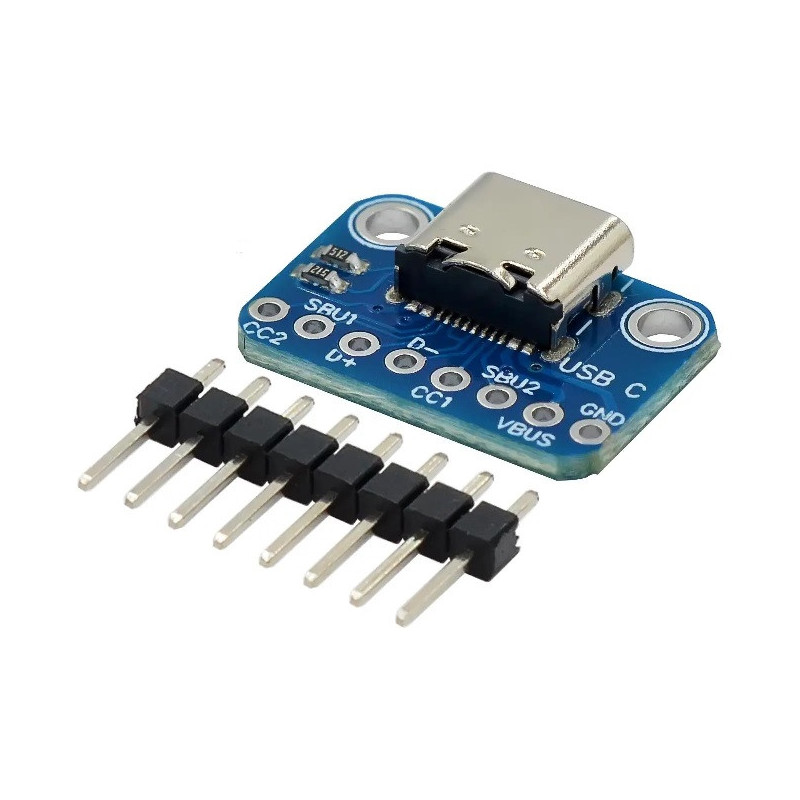

USB-C female breakout board to 2.54mm DIP, supplier reference 108.MD9245, suitable for prototypes and electronic projects. It converts the USB-C connector to easy-access pins, including GND, VBUS +5V, D+, D-, CC1 and CC2, with 5.1kΩ pull-down resistors on CC1/CC2.

Security policy

Delivery policy
Is a breakout board with a USB-C female connector, designed to make USB-C easier to use in prototypes, test boards, breadboards and electronic projects.
This module converts the small contacts of a USB Type-C connector into a 2.54mm DIP pin format, allowing easier connection to boards such as Arduino, ESP32, Raspberry Pi, development modules and custom circuits, provided that the power and signal levels are compatible.
The board includes 5.1kΩ pull-down resistors on the CC1 and CC2 pins, used in USB-C for cable orientation and connection detection. This configuration helps the board be detected as a USB-C device and receive power through the VBUS +5V line.
In addition to power, the board also provides D+ and D- lines, used for USB 2.0 communication when the connected circuit is compatible and correctly implemented.
It is a practical solution for adding a USB-C input to DIY projects, prototypes, small power boards, test modules, adaptations and electronics experiments without soldering directly to the small USB-C connector contacts.
Main features
USB-C breakout board
Connector type: USB-C female
Output format: DIP / 2.54mm pins
Pin pitch: 2.54mm
Available pins: GND, VBUS, D+, D-, CC1 and CC2
Power line: VBUS +5V
Data lines: D+ and D- for USB 2.0
CC1/CC2 resistors: 5.1kΩ pull-down
Main application: USB-C adaptation for prototypes
Breadboard / protoboard compatible: yes, depending on assembly
Suitable for Arduino, ESP32, Raspberry Pi and other compatible projects
Module type: adapter board / breakout board
Mounting: pin header / soldering to PCB or protoboard
Suitable for prototypes, 5V power input and USB-C testing
Recommended applications
USB-C prototypes
Arduino projects
ESP32 projects
Raspberry Pi projects, when compatible
Breadboards and test boards
USB-C connector adaptation to 2.54mm pins
Powering small circuits from VBUS +5V
Testing USB 2.0 D+ and D- lines
DIY electronics projects
Development modules
Electronic repairs and adaptations
Adding USB-C input to custom boards
Important note
Before use, always confirm the pinout, connector orientation, voltage available on VBUS, current required by the circuit, D+/D- line compatibility and CC1/CC2 connections. This breakout board makes the USB-C connector easier to access, but it does not replace a complete USB management, battery charging or USB Power Delivery negotiation circuit.
The VBUS line should be treated as standard USB +5V power, unless otherwise confirmed in the circuit being used. Do not apply higher voltages or connect high-current loads without checking the capability of the USB power source, cable and the board itself. Incorrect wiring may damage the module, USB power supply or connected equipment.
Data sheet
USB-C female breakout board to 2.54mm DIP, supplier reference 108.MD9245, suitable for prototypes and electronic projects. It converts the USB-C connector to easy-access pins, including GND, VBUS +5V, D+, D-, CC1 and CC2, with 5.1kΩ pull-down resistors on CC1/CC2.