- New
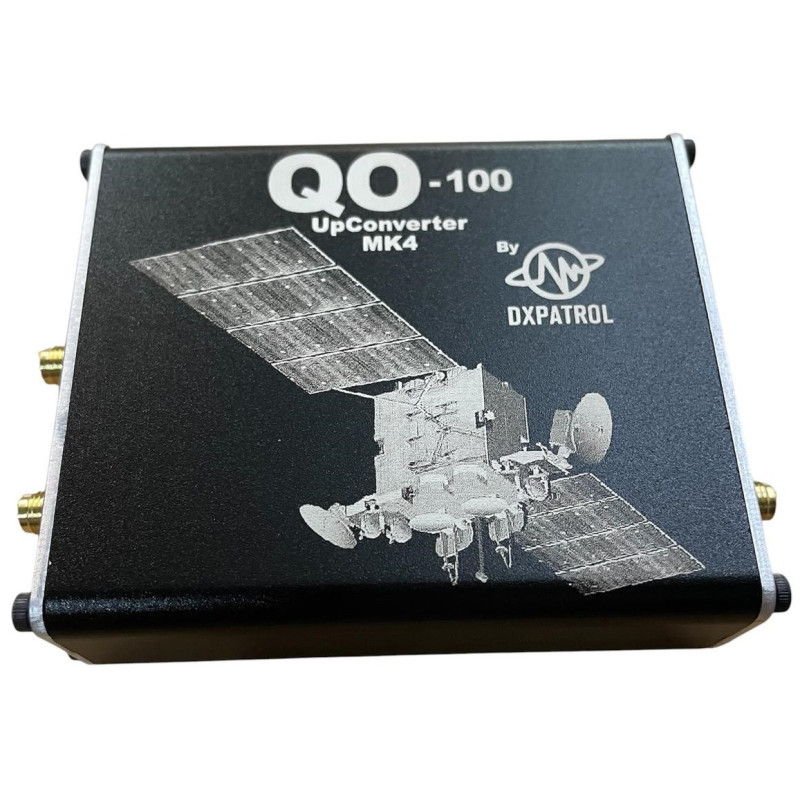


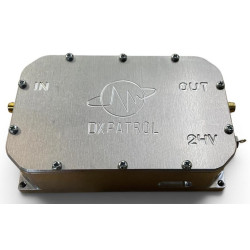
Upconverter for transmitting through the QO-100 satellite, with selectable 28, 144, 432 or 1296 MHz IF inputs and output in the 2.4 GHz band. It features an internal 10 MHz TCXO, an external GPSDO input and RF VOX.

Security policy

Delivery policy
The DXpatrol UpConverter MK4 converts an RF signal from a transceiver operating on the 10 m, 2 m, 70 cm or 23 cm amateur bands to the 2.4 GHz uplink band used by the QO-100 geostationary satellite.
Four intermediate-frequency configurations are factory programmed and selected through an internal DIP switch. This flexibility allows different amateur radio transceivers to be used as the IF signal source.
The local oscillator uses an Analog Devices ADF4351 synthesiser, locked to an internal 10 MHz TCXO with 500 ppb stability. For greater frequency accuracy, an external 10 MHz reference from a compatible GPSDO can be used.
The RF VOX function automatically switches the unit into transmit mode when it detects more than approximately 100 mW at the IF input. When the signal disappears, the converter remains in transmit mode for approximately 250 ms before returning to standby.
The output can reach 200 mW or 23 dBm, although it is factory adjusted to approximately 90 mW. This level is normally intended to drive an external 2.4 GHz power amplifier.
The exact output frequency is the sum of the selected local oscillator frequency and the applied IF frequency.
The recommended input power is 1 to 3 W and must never exceed the 6 W absolute maximum. Excessive input power may permanently damage the converter.
Using the 28 MHz input may increase unwanted signals and require an additional band-pass filter between the upconverter and power amplifier. For best performance, the manufacturer recommends using 144 MHz or a higher IF whenever possible.
The 90 to 200 mW output is normally intended to drive a 2.4 GHz power amplifier. The power supply, GPSDO, amplifier, antenna, cables and adapters are not stated as included.
Transmitting through QO-100 requires a valid amateur radio licence and compliance with the regulations applicable to the amateur service.

Upconverter for transmitting through the QO-100 satellite, with selectable 28, 144, 432 or 1296 MHz IF inputs and output in the 2.4 GHz band. It features an internal 10 MHz TCXO, an external GPSDO input and RF VOX.